
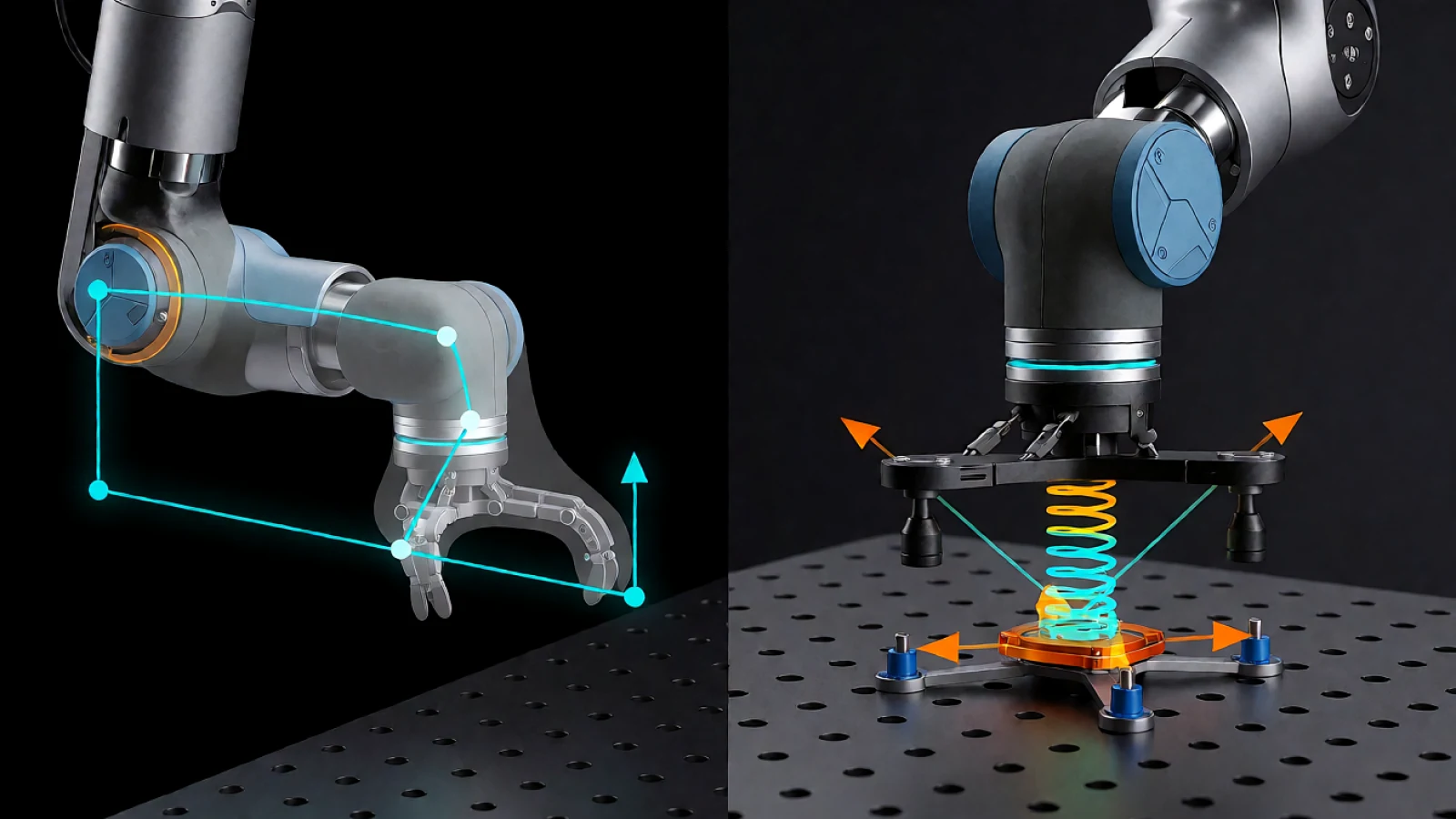
The short comparison
| Control approach | Primary objective | Typical strength | Main limitation in contact | |---|---|---|---| | Position or motion control | Track a desired joint or endpoint trajectory | Accurate, repeatable movement in free space | Small position errors can create large or unintended contact forces | | Force control | Track a desired contact force or wrench | Regulates interaction when contact is established | Requires suitable force estimation and stable contact behavior | | Hybrid motion–force control | Control motion in some directions and force in others | Separates free-motion and constrained-contact objectives | Requires a correct model of which directions are constrained | | Impedance control | Regulate the dynamic relationship between motion and force | Can provide compliant, spring-like interaction rather than rigid tracking | Behavior depends on chosen parameters, sensing and implementation |
These are not mutually exclusive product features. A humanoid can use different methods across joints, tasks and phases of one action.
The standard reference text Modern Robotics treats motion control, force control, hybrid motion–force control and impedance control as related but distinct robot-control objectives. That framework is more useful than asking whether a whole fighting robot “uses position or force control” as if only one answer were possible. This distinction belongs to the broader field of humanoid robotics engineering.
What position control does
Position control compares a desired configuration or trajectory with the robot’s estimated state and commands actuator action to reduce the error.
At joint level, the target may be an angle and its time evolution. At task level, it may be the pose of a hand, foot or torso. A whole-body controller can coordinate many such objectives while respecting balance and joint constraints.
Position-based control is valuable for:
- repeatable guard and preparation postures;
- stepping trajectories;
- free-space arm and leg movements;
- returning a limb after a strike;
- executing a learned motion reference;
- maintaining a desired stance when conditions permit.
The key word is trajectory. A controller can be designed to track not just a final position but how the robot gets there.
Why rigid position tracking becomes difficult at contact
Suppose the commanded hand position lies slightly inside a solid target. The position error does not disappear when contact occurs. A stiff controller may continue commanding effort to reach an unreachable position, producing a large interaction force.
Real robots are not perfectly rigid, and controllers are not infinitely stiff. Nevertheless, the principle remains: a small geometric mismatch can have large force consequences when the system resists motion.
For a humanoid, unexpected contact also propagates through the body. A hand target that is appropriate in free space may become incompatible with foot support and balance after impact.
What force control does
Force control regulates an interaction force or, more generally, a force-and-moment quantity called a wrench. The target might be a desired normal force against a surface or a controlled contact load during manipulation.
A force-controlled task needs an estimate of the relevant interaction. This can come from dedicated force/torque sensing, joint-torque information, tactile sensing or model-based estimation, depending on the system.
Force control is useful when:
- maintaining a specified contact rather than a fixed position;
- limiting or regulating pressure against an object;
- coordinating contacts with a surface;
- controlling interaction during constrained motion.
It is not a license to apply unlimited force. The controller normally tracks a chosen reference and must remain stable under sensor noise, delays, contact changes and actuator limits.
Force control is not the same as torque control
These terms are related but not interchangeable.
- Joint-torque control regulates actuator or joint torque.
- Endpoint force control regulates force at a hand, foot or other interaction point.
- Whole-body force distribution may allocate contact and joint efforts across several limbs.
Joint torque influences endpoint force through the robot’s configuration and dynamics. External contact, friction, transmission effects and model error complicate the relationship.
Motor current can be useful for estimating actuator torque, but current alone does not directly measure every external contact force. A gearbox, linkage and accelerating limb also participate in the physics.
Hybrid motion–force control: divide the task by direction
Hybrid control assigns motion and force objectives to different directions.
A classic example is moving along a surface while regulating pressure against it. One direction is constrained by contact; another remains available for motion.
For a humanoid task, a conceptual decomposition could involve:
- controlling position or velocity along a free direction;
- regulating normal force along a constrained direction;
- updating that decomposition when contact begins or ends.
This works best when the controller knows the contact geometry. In a fight, contact can be brief, angled and unpredictable. The opponent may move away, rotate or collapse the expected constraint. A fixed hybrid decomposition can therefore become invalid quickly.
That is one reason a boxing strike should not be described as ordinary sustained force control. Much of the action occurs before contact, and the impact itself is a transient collision rather than a long, stable force-tracking task.
Impedance control: choose how the robot responds
Instead of demanding a perfectly rigid trajectory or a single contact force, impedance control regulates a dynamic relationship between motion and interaction.
A common conceptual model is a virtual mass–spring–damper system:
- spring-like behavior determines how force relates to displacement;
- damping shapes the response to velocity;
- inertial behavior shapes dynamic response.
The controller can make an endpoint behave more compliant or more stiff within hardware and safety limits. This can help absorb mismatches and manage contact without abandoning motion objectives entirely.
A related approach, admittance control, uses measured interaction force to modify a commanded motion. Implementations vary, so the labels should not be reduced to one universal block diagram.
Compliance is not weakness
A compliant response can protect hardware and improve contact behavior. It does not mean the robot cannot move quickly or deliver a meaningful impact.
Conversely, maximum stiffness is not always desirable. A very stiff system may transmit more disturbance through the structure or respond poorly to an unexpected constraint. The useful behavior depends on the task phase and physical design.
Software compliance also has limits. Padding, structural elasticity, joint design and energy-absorbing hardware affect what happens during a real collision.
A humanoid strike has several control phases
A punch or kick can be analyzed as a sequence rather than one control mode.
1. Preparation and guard
The robot establishes a stance, positions its limbs and prepares whole-body motion. Motion tracking and balance objectives are central.
2. Free-space acceleration
The striking limb moves toward the target while the rest of the body compensates. The controller must track a feasible movement without violating support and joint constraints.
3. Contact transition
The expected free-space motion changes abruptly when contact occurs. Impact forces, target movement and the robot’s own momentum alter the state. This is not a quasi-static force-regulation problem.
4. Post-contact response
The target may move away, the strike may glance off, or the robot may recoil. The controller must prevent the original trajectory from becoming unsafe or destabilizing.
5. Recovery to fighting stance
The limb returns, the feet and torso reestablish a usable configuration, and balance control prepares for the next action. A miss requires a different recovery from a hit because expected contact never arrives.
Different controllers or parameter sets can hand off across these phases. Public fight footage rarely exposes those internal transitions.
Balance changes the force-control problem
A fixed industrial arm can often treat its base as stable. A humanoid’s base is supported through changing foot contacts and can fall.
That means arm or leg contact objectives cannot be considered independently. The robot must coordinate:
- hand or striking-limb motion;
- torso and free-limb movement;
- foot-contact forces;
- center-of-mass and whole-body momentum;
- joint, friction and actuator limits;
- recovery when the current plan becomes infeasible.
An impact on the hand can disturb the feet. A kick changes which leg supports the body. A force command that looks reasonable for an isolated limb may be unacceptable for the full humanoid.
Our dedicated guide to how humanoid robots balance covers the feedback loop in more detail. The important point here is that contact control and balance are coupled, not separate modules that can be evaluated only in isolation.
Does a harder punch require force control?
Not necessarily in the simple sense of tracking a large force setpoint.
Impact force emerges from the striker’s motion, effective mass, whole-body dynamics, contact mechanics and target response. A controller may generate a fast, coordinated motion and manage the resulting contact rather than track one force value throughout the collision.
A team might optimize for:
- accurate approach and timing;
- whole-body coordination;
- controlled compliance at contact;
- stable recoil and recovery;
- repeatable results under a defined test protocol.
Increasing a force reference without considering these factors can reduce accuracy, destabilize the robot or exceed thermal and mechanical limits.
To quantify the result, use an instrumented target rather than infer force from controller mode. See how to measure humanoid punch force.
What sensing does each approach need?
All closed-loop approaches need timely state information, but their critical measurements differ.
Motion control relies heavily on joint and body-state estimation, plus task-space tracking where required.
Force control additionally needs a useful estimate of the interaction force or wrench. Sensor location, contact geometry and force paths matter.
Hybrid control needs both motion and force information plus a valid decomposition of constrained and free directions.
Impedance or admittance schemes may combine position, velocity, force and actuator measurements according to the implementation.
Camera and LiDAR observations can help locate a target, but they do not directly measure contact force. The T800’s listed binocular cameras and 3D LiDAR therefore do not tell us which low-level contact controller it uses. Our T800 sensor guide keeps those claims separate.
Can we identify the T800’s controller from its specifications?
No. EngineAI publishes joint type, maximum torque, degrees of freedom, sensing, computing and cooling configurations. Those details describe platform resources, not a complete control law.
The public product table does not specify, for every fighting action:
- position, velocity or torque-command interfaces;
- force/torque sensors and estimators;
- hybrid control assignments;
- impedance parameters;
- impact-transition logic;
- whole-body force allocation;
- the boundary between human and autonomous tactical commands.
It would therefore be inaccurate to declare that URKL robots are “pure position controlled” or “pure force controlled” based on a replay or actuator specification.
Developer documentation and exact edition APIs matter for researchers, but even API access does not reveal which proprietary event policy a team deployed.
How to evaluate a humanoid contact controller
A useful test goes beyond successful-looking motion. Record:
- joint and endpoint tracking errors before contact;
- contact timing and force-time waveforms;
- peak force, impulse and unintended secondary contacts;
- body-state and foot-contact changes;
- balance violations, falls and recovery outcomes;
- behavior on both hits and misses;
- repeatability across targets and initial conditions;
- actuator, compute and thermal limits;
- response to sensor noise, delay or lost contact;
- safe stopping and mode-transition behavior.
These measurements distinguish a controller that looks effective in one clip from one that manages physical interaction reliably.
The engineering takeaway
Position control answers “Where should the robot move?” Force control answers “How should it regulate physical interaction?” Hybrid and impedance methods connect those objectives.
Humanoid combat requires all of these ideas around a harder constraint: the robot must remain balanced while contact conditions change rapidly. A successful strike is therefore not proof of one superior control mode. It is evidence of a complete hardware, sensing, motion and recovery system working through a particular sequence.