
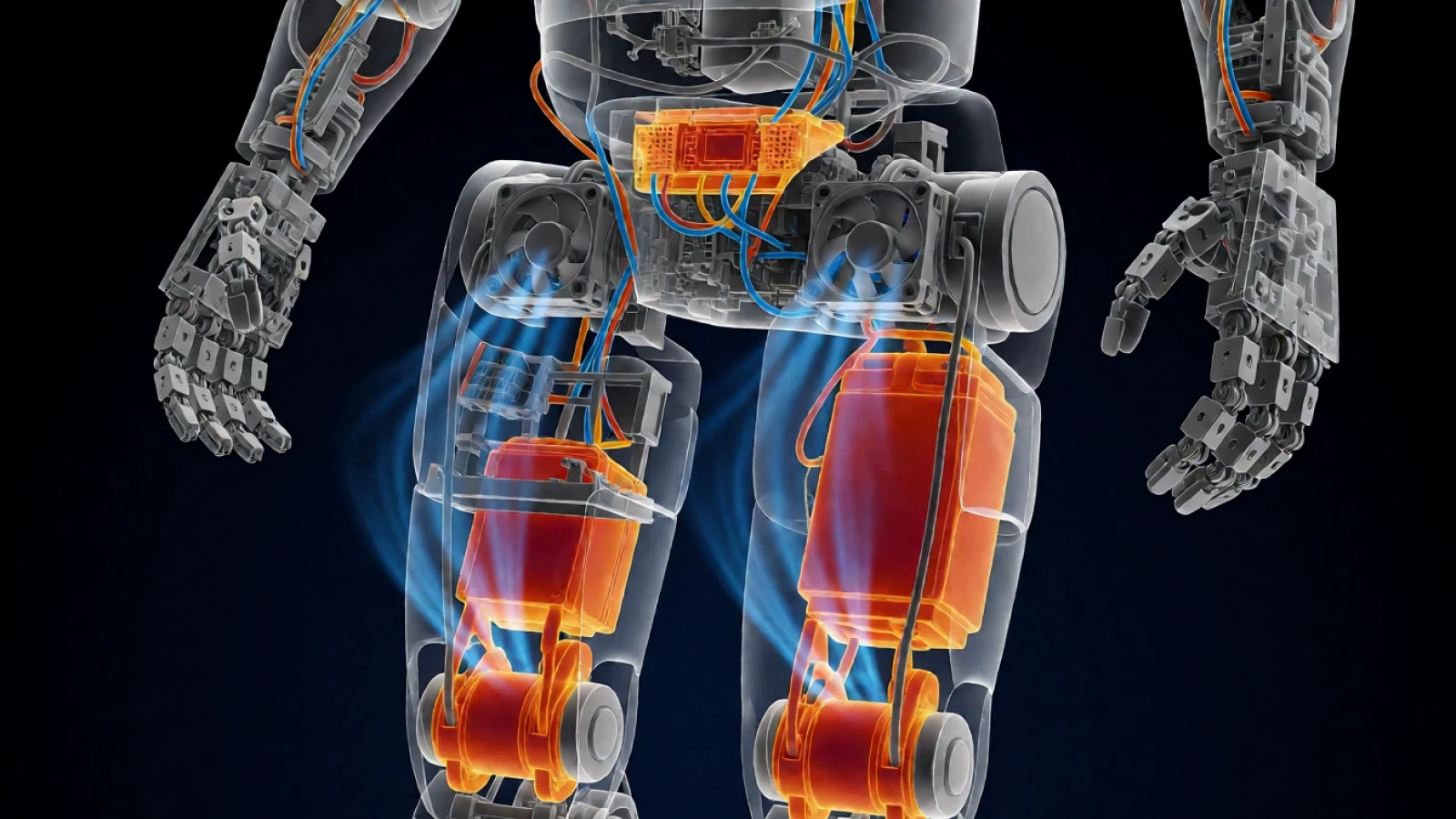
Why combat is a thermal problem, not just a torque problem
A robot may deliver an impressive action from a cool state and still perform differently after repeated strikes, steps and recoveries. Every dynamic movement draws electrical power, and not all of that power becomes useful mechanical motion. Losses become heat.
Combat concentrates difficult conditions:
- high-current actuator bursts;
- rapid acceleration and braking;
- repeated whole-body stabilization;
- impacts and mechanical resistance;
- sustained sensing and computing;
- limited space for airflow and heat sinks;
- short recovery windows between efforts.
The relevant question is therefore not only “How much torque can this joint produce?” It is also “For how long, at what ambient temperature, with what duty cycle, and what happens next?”
EngineAI’s T800 page lists maximum joint torque of up to 450 N·m but does not turn that figure into a continuous combat-torque rating. Those are different engineering claims.
Our engineering hub covers the related limits on torque, power and control.
Where humanoid heat comes from
| Subsystem | Important heat sources | Why combat matters | |---|---|---| | Joint motors | Electrical winding losses, magnetic losses and mechanical losses | High current and repeated acceleration increase thermal load | | Motor drives | Conduction and switching losses in power electronics | Drives repeatedly regulate large, changing currents | | Transmission and structure | Friction and other mechanical losses | Impacts and loaded motion add dissipation and stress | | Battery | Internal electrical losses during charge and discharge | High power demand and repeated bursts heat the pack | | Onboard computing | CPU, GPU, accelerators, memory and power conversion | Perception, policies and logging can run concurrently with motion | | Power conversion and wiring | Conversion losses, resistance and connectors | Distribution losses rise with system current |
One familiar motor-loss term is resistive or copper loss, commonly represented as I²R. It rises strongly with current, although a complete motor model includes additional losses. This is one reason peak output and thermally sustainable output cannot be treated as identical.
The robot is a coupled system. A hot computer can share enclosure space with power electronics; a warm battery can reduce available thermal margin; and a cooling fan itself consumes power.
Peak torque versus continuous performance
A peak rating describes a limit under stated or implied conditions. Continuous capability depends on how heat is generated and removed over time.
A simplified thermal view has three parts:
- Heat generation: electrical and mechanical losses.
- Thermal storage: components temporarily absorb heat and warm up.
- Heat rejection: conduction, radiation and airflow carry heat toward the environment.
A short burst can be possible before temperatures reach their limits. Repeating that burst reduces recovery time and can raise the temperature baseline for the next action.
This produces a duty-cycle problem. Ten spectacular actions separated by long cooling periods are not equivalent to the same actions delivered during a physically active round. A fair endurance test must disclose timing and rest conditions.
Our EngineAI T800 profile explains why maximum torque should not be interpreted as punch force. Thermal analysis adds another boundary: it should not automatically be interpreted as continuous torque either.
What active cooling actually does
Active cooling uses a device such as a fan to increase heat transfer. It can improve the path from a warm component to the surrounding air, but it does not erase heat at the source.
Cooling performance depends on:
- thermal contact between the heat source and heat spreader;
- heat-sink geometry and available surface area;
- airflow rate and flow direction;
- inlet and ambient air temperature;
- dust, obstruction and protective covers;
- fan control and operating condition;
- how several subsystems share the enclosure.
EngineAI lists “Super Air-Cooled Heat Dissipation” across the T800 range and separately markets active cooling for full leg joints. The page says this supports sustained performance under heavy loads and high temperatures.
Those statements identify a design focus. They do not disclose fan curves, thermal resistance, joint temperatures, continuous current limits or measured performance across repeated URKL rounds. The claim should therefore be attributed to EngineAI rather than converted into a numerical endurance conclusion.
Computing has its own thermal limits
High-computing modules are not immune to thermal constraints. NVIDIA’s Jetson Orin documentation describes temperature sensing, fan-based cooling, software and hardware clock throttling, and thermal shutdown mechanisms.
This creates a useful distinction:
- Active cooling removes heat, for example through a fan.
- Passive thermal control through throttling reduces computational performance to reduce heat generation.
- Critical protection can initiate shutdown behavior to protect the system.
If perception or policy computation slows under thermal pressure, the consequences may extend beyond a lower benchmark score. Sensor processing rates, latency or concurrent logging may change. Safety-critical control architecture must remain predictable under those conditions.
The T800’s Orin NX, AGX Orin and optional Thor configurations should therefore be tested under the intended power mode and full concurrent workload. Our T800 computing guide explains the edition differences.
Batteries belong in the thermal analysis
Battery discussions often stop at runtime. A fight team also needs to consider temperature, power delivery and the condition of the pack.
Repeated high-power motion and recovery actions produce a different load profile from slow standing or walking. Battery behavior also changes with state of charge, age, cell temperature and configuration.
EngineAI lists a quick-disassembly smart battery and a 3–5 hour runtime range in the T800 product tables. Separate battery marketing uses up to four hours. Neither statement supplies a combat thermal curve or proves continuous full-contact operation for that duration.
A quick-swap design can help operational turnaround, but swapping a battery does not cool hot motors, drives or computers. Thermal state persists elsewhere in the robot.
For the battery claims themselves, see our T800 solid-state battery analysis.
What happens when a robot gets too hot?
The exact response depends on the subsystem and manufacturer. Possible protective responses include:
- limiting current or torque;
- reducing computational clocks;
- changing fan speed;
- issuing a warning or fault;
- preventing further motion;
- initiating a controlled shutdown.
These behaviors can protect hardware while changing performance. A robot may move less aggressively, process data more slowly or require a reset. No public T800 combat threshold table is supplied in the sources used here, so specific temperature limits should not be invented.
Thermal protection should not be disabled to preserve a show or a test result. That would undermine both safety and the validity of the performance claim.
Rest periods are not proof of thermal recovery
Section 8 of URKL’s V2.0.0 rules describes five-minute rounds, three-minute rest periods and a three-minute technical-timeout allowance per round. Those windows create opportunities for inspection and intervention.
They do not demonstrate that every component returns to its starting temperature. Cooling depends on the prior load, airflow, ambient conditions and what the team does during the interval.
A robot can begin the next round warmer than it began the previous one. This cumulative effect is why multi-round temperature logging is more informative than one post-fight external reading.
How to build a useful combat thermal test
A rigorous evaluation should reproduce a declared workload and record synchronized data.
Define the workload
Specify the action sequence, strike count, stepping, recovery attempts, idle periods and contact conditions. Include the robot edition, software, computing power mode and ambient environment.
Measure more than shell temperature
Use available internal motor, drive, battery and compute sensors. An infrared camera or external temperature probe can supplement them, but a cool cover does not prove that an internal winding or chip is cool.
Record performance with temperature
Log joint output or current where available, action completion, control timing, perception rates, compute clocks, throttling flags, battery state and faults. Temperature alone does not reveal whether capability changed.
Repeat through several cycles
Run enough work-and-rest cycles to show whether temperatures stabilize or continue rising. Include the same rest procedure planned for actual operation.
Publish limits and invalid trials
Document stops, faults and excluded attempts. A thermal test that hides protective shutdowns gives a falsely optimistic picture of sustained performance.
Metrics that matter more than “it feels cool”
Useful thermal metrics include:
- peak and end-of-cycle temperature by subsystem;
- temperature rise above ambient;
- time to reach a warning or limit;
- recovery rate during rest;
- performance change at a given temperature;
- number and duration of throttling events;
- successful actions per thermal cycle;
- energy consumed per completed action sequence;
- repeatability across units and ambient conditions.
The best cooling system is not simply the one with the most visible fans. It is the one that preserves safe, predictable task performance under a disclosed workload.
What is still unknown for the T800?
The public product page establishes the cooling marketing and broad configurations, but not:
- continuous torque by joint at stated temperatures;
- winding, drive and battery temperature limits;
- complete airflow paths;
- combat duty-cycle ratings;
- multi-round thermal curves;
- compute-throttling behavior inside a URKL fighter;
- performance after repeated impacts and maintenance.
Those omissions do not prove poor cooling. They define what cannot yet be concluded from public information.
The engineering takeaway
Thermal management connects actuator strength, battery performance, onboard computing and fight reliability. Peak motion demonstrates what a robot can do once; thermal evidence shows what it can keep doing.
EngineAI’s active leg-joint cooling is a relevant T800 design claim. The next level of proof would be synchronized multi-round data showing temperatures, output, throttling and recovery under a repeatable combat workload.