
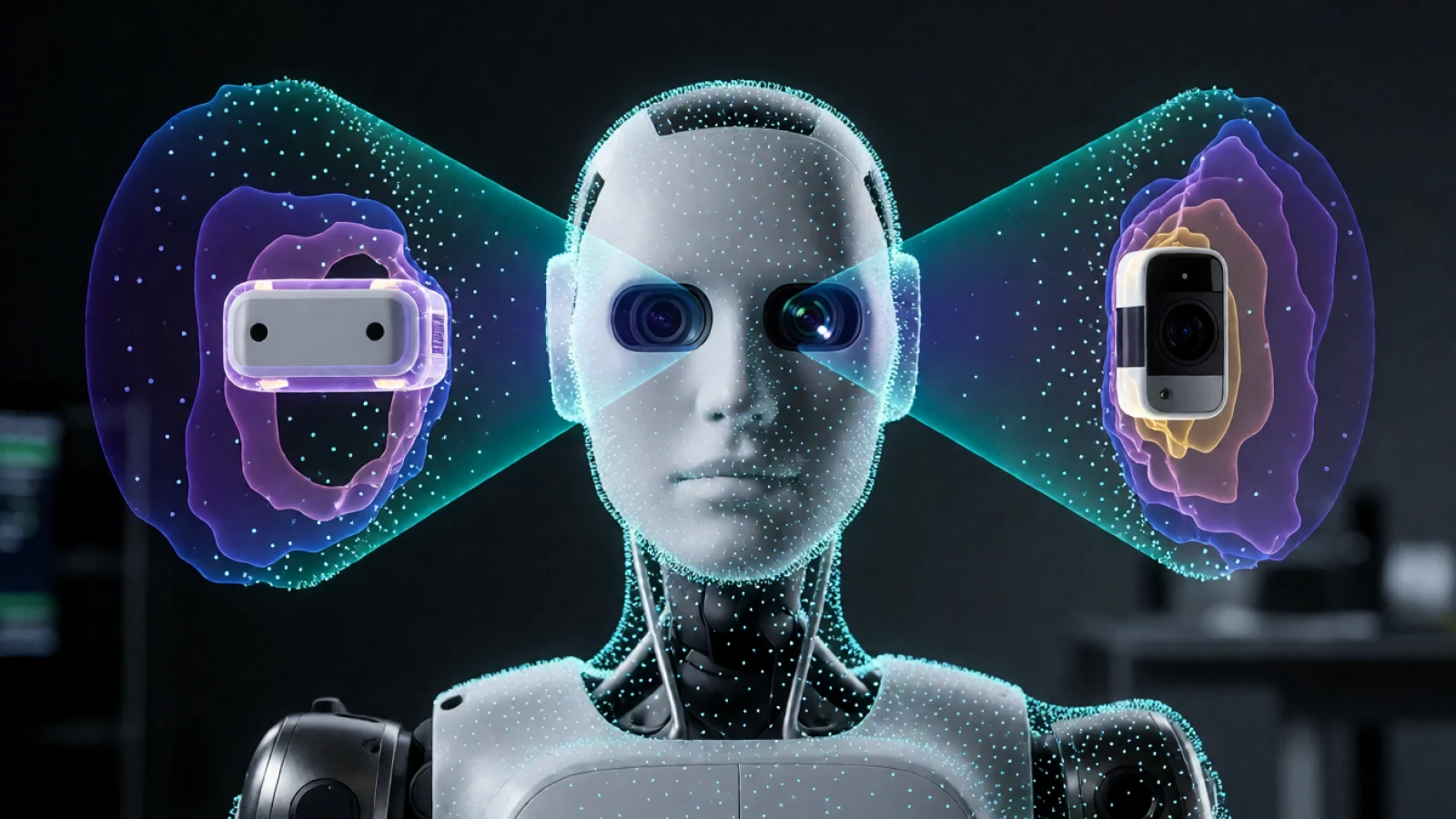
Official T800 sensors by edition
The sensor configuration changes across the T800 range, so “the T800 has LiDAR” is not an accurate description of every listed edition.
| T800 edition | Published head camera | Published 3D LiDAR | Secondary development | |---|---|---|---| | Basic | Intel wide-field-of-view binocular camera | Not listed in the product table | Not listed | | Open Source | Ultra-wide-field-of-view binocular camera | Listed | Listed | | Pro | Ultra-wide-field-of-view binocular camera | Listed | Listed | | Max | Ultra-wide-field-of-view binocular camera | Listed | Listed |
The same official table lists an eight-core CPU across the range and different high-computing modules by edition. Those compute choices matter because sensor data still has to be processed, synchronized and converted into useful state estimates.
This article describes the commercial configurations published by EngineAI, not the exact sensing package of every URKL fighter. A competition robot may be configured for a particular event, and public fight footage does not provide a complete hardware inventory.
For related platform profiles and technical analysis, browse our robot encyclopedia.
What a binocular camera contributes
A binocular camera uses two image viewpoints. Corresponding features in those views can be used to estimate depth through stereo vision. In a humanoid system, that information can contribute to tasks such as:
- estimating the shape and position of nearby objects;
- detecting free space and obstacles;
- supporting visual localization;
- tracking a target or another robot;
- supplying visual input to learned perception policies.
The T800’s published “wide” or “ultra-wide” field of view is relevant because a broader view can retain more of the surrounding scene as the body moves. That is especially useful when the head and torso rotate during whole-body actions.
A wider view is not automatically better in every respect. Lens distortion, image resolution, depth accuracy, calibration, exposure and processing cost all affect the usable result. EngineAI’s public table does not provide a common stereo-depth benchmark for fight conditions.
Stereo vision has physical limits
Stereo depth depends on visual information. Performance can change with lighting, low-texture surfaces, motion blur, occlusion and the distance to the target. In an arena, another robot, a referee, protective structures or the fighter’s own limbs can block the cameras’ view.
An impact can add vibration or abrupt motion. A camera may therefore provide useful information without maintaining an uninterrupted, perfect model of the fight.
What 3D LiDAR adds
LiDAR measures the environment using laser returns to produce spatial range information. A 3D LiDAR can complement cameras by providing geometric observations that do not depend on scene texture in the same way stereo matching does.
Potential uses include:
- building or updating a spatial map;
- estimating the robot’s position within that map;
- detecting nearby structures and obstacles;
- checking free space around the body;
- providing another perception source when vision is degraded.
EngineAI also markets a 360-degree omnidirectional perception system and 360-degree LiDAR on the T800 page. That is a manufacturer description of the platform’s perception design, not a published autonomous-boxing evaluation.
LiDAR has limitations too. The public page does not specify the model, point rate, range, accuracy, field-of-view envelope, latency or performance against every arena material. A checkmark in a specification table cannot answer those engineering questions.
Cameras and LiDAR are not the whole state-estimation problem
A fighting humanoid needs more than an external view of the opponent. It also needs an estimate of its own body state: joint configuration, body orientation, motion, foot contact and stability.
External perception and body-state estimation answer different questions:
| Question | Typical information needed | |---|---| | Where is the opponent or an obstacle? | Camera, depth or LiDAR observations | | How is my own body moving? | Joint and inertial/body-state information | | Which contacts support the robot? | Contact estimation and whole-body state | | Can the planned action remain balanced? | Dynamics, control state and environmental estimates | | What action should happen next? | A policy, planner or human command |
The T800 product page does not disclose a complete sensor-and-estimation architecture covering all of these rows. It would therefore be wrong to infer that binocular vision and LiDAR, by themselves, solve balance or contact control.
Our guide to how humanoid robots balance explains why fast local feedback remains necessary even when a robot has rich external perception.
Sensor fusion is where hardware becomes useful information
Sensor fusion combines imperfect observations into estimates that other software can use. A perception pipeline may need to:
- synchronize observations from different devices;
- transform them into shared coordinate frames;
- reject outliers and handle missing measurements;
- track objects while the robot itself moves;
- estimate uncertainty rather than treating every detection as certain;
- deliver information before it becomes stale.
Calibration is central. If the estimated relationship between a camera, LiDAR and body frame is wrong, geometrically consistent data can still produce an incorrect scene model. Repeated impacts make mounting and calibration quality especially relevant.
Latency matters as well. A precise opponent position from an earlier moment may be less useful than a less precise estimate delivered on time. The T800 page’s “millisecond-level data processing” wording is a broad manufacturer claim; it does not publish an end-to-end fight-latency test.
Why robot combat is a difficult perception environment
Robot boxing combines several adverse conditions in one setting:
- Self-occlusion: arms, legs and torso can block sensors.
- Opponent occlusion: the target may disappear behind another body.
- Fast viewpoint changes: strikes and recovery actions rotate the head and trunk.
- Contact and vibration: collisions can disturb images and sensor alignment.
- Similar-looking equipment: arena structures and robot parts may complicate tracking.
- Changing contact states: seeing a foot near the floor is not the same as knowing its load.
- Short decision windows: old information can produce a badly timed response.
A robot can therefore possess good sensors and still make an incorrect decision. Conversely, a simple-looking demonstration may rely on constrained conditions rather than general visual intelligence.
Does the T800 sense autonomously or fight autonomously?
Those are separate claims. A perception system can generate depth, maps or detections autonomously while a human supplies tactical commands. A remote-controlled fighter can still use automatic stabilization and onboard perception.
To establish autonomous combat, evidence would need to show which system performs:
- opponent detection and tracking;
- tactical action selection;
- movement planning;
- balance and recovery;
- safety responses;
- adaptation when the opponent behaves unexpectedly.
The official product table establishes sensor configurations. It does not publish a complete allocation of those functions between human operators and software during URKL bouts.
For the related computing distinction, see T800 Orin NX, AGX Orin and Thor. For a broader explanation of control modes, read autonomous versus remote-controlled robot boxing.
What buyers and researchers should ask for
A serious technical evaluation should go beyond “camera plus LiDAR.” Request information about:
- exact sensor models and firmware versions;
- camera resolution, frame rate, exposure and stereo baseline;
- LiDAR range, accuracy, update rate and coverage;
- timestamping and hardware or software synchronization;
- intrinsic and extrinsic calibration tools;
- raw-data access and supported message formats;
- onboard processing requirements and measured latency;
- behavior under occlusion, vibration and changing light;
- recalibration needs after maintenance or impacts;
- APIs available on the specific development edition.
These questions also prevent an edition mismatch. A software plan that depends on the published LiDAR configuration should not assume that T800 Basic includes the same listed package as Open Source, Pro or Max.
Our EngineAI T800 profile separates the four editions across articulation, sensing, compute and development support.
The engineering takeaway
The T800’s strongest documented sensor distinction is simple: Basic lists a binocular head camera without 3D LiDAR in the table, while the three development-oriented editions list an ultra-wide binocular camera and 3D LiDAR.
That difference can materially affect a perception project. It does not, on its own, quantify combat awareness, prove autonomous tactics or reveal the exact configuration of a named URKL fighter. Sensor specifications are the beginning of a perception evaluation—not its result.