
Why Shanghai’s two-against-one format matters
A one-on-one bout already requires each humanoid to estimate its own state, move and respond to contact. Adding a third robot creates a team-coordination problem as well. These challenges sit at the core of humanoid robot engineering.
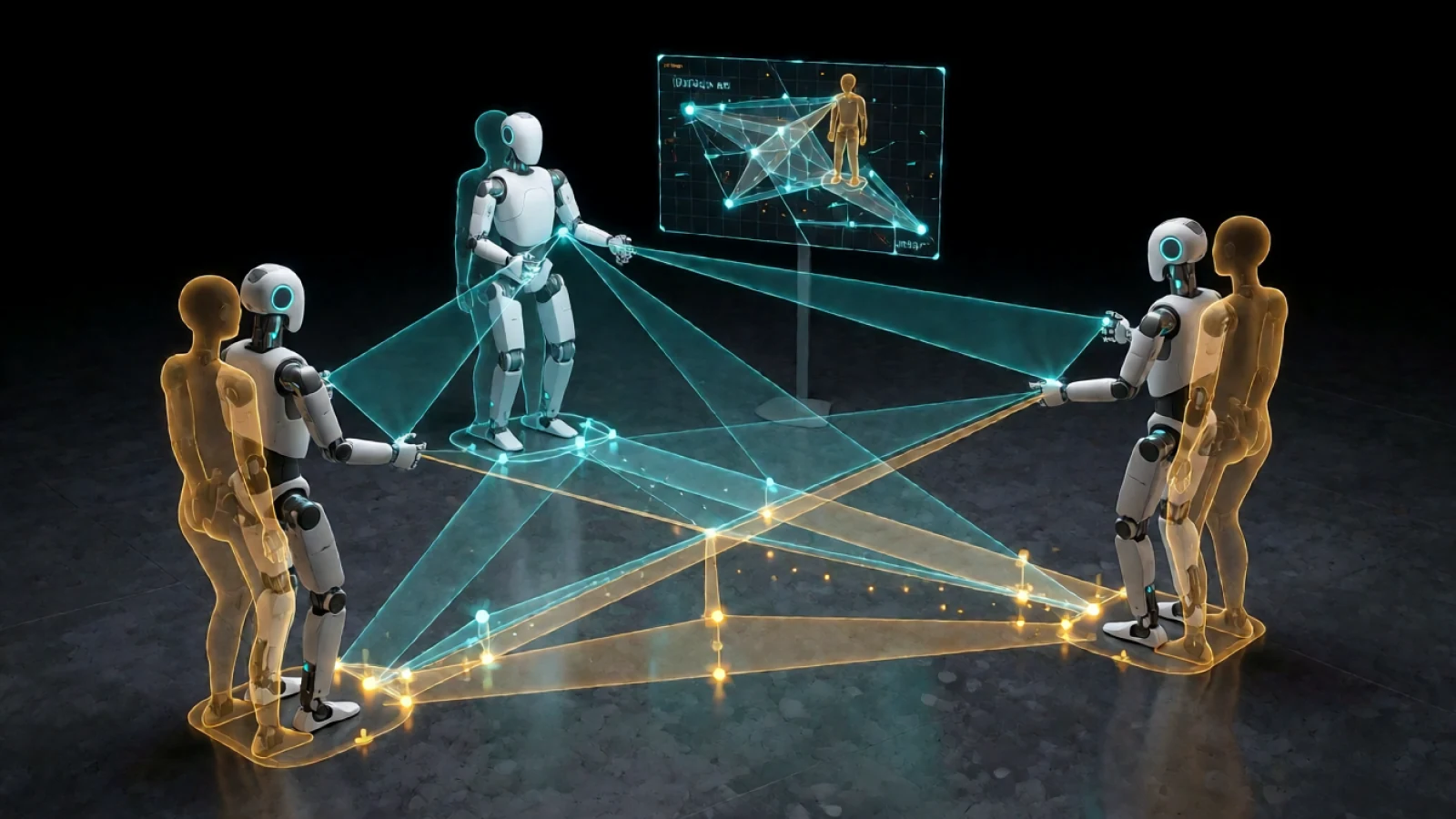
At Shanghai’s September 2026 event, White Eagle and Golden Flash faced Matador in a reported two-against-one showcase. Official event coverage described the format as more than three independent machines repeating individual routines. The organizers attributed capabilities including distributed perception, dynamic role changes and coordinated relative positioning to the system.
That makes the event relevant to multi-humanoid research. It does not make every algorithm public. The sources do not disclose the complete network topology, message contents, tactical-autonomy boundary, latency distribution or software stack.
For the event-specific account, read our URKL Shanghai two-versus-one format guide. This article focuses on the engineering required by such a format rather than the match report.
Communication, coordination and collaboration are different
A 2026 survey of networked humanoid intelligence separates several concepts that are often blurred:
- Communication: what information is exchanged, with whom, when and through which resources.
- Coordination: how decisions and actions remain compatible.
- Collaboration: how capabilities, information, forces or experience are combined for a joint result.
Three robots can communicate without coordinating. For example, they might broadcast positions while still choosing conflicting movements. They can also coordinate without physical collaboration, such as reserving separate space and action timing.
In a combat showcase, the team needs more than connectivity. It needs compatible decisions under changing contact and balance conditions.
A shared world model starts with coordinate frames
Each robot observes the arena from its own moving body. Its camera or LiDAR data is initially expressed relative to its own sensors. To share that information usefully, the system needs spatial and temporal alignment.
A shared representation may include:
- estimated positions and orientations of teammates;
- opponent tracks and uncertainty;
- arena boundaries and obstacles;
- current body states and contact conditions;
- intended footsteps or movement corridors;
- current roles and plan version;
- timestamps and information-validity intervals.
Coordinate calibration matters. If robots disagree about where the arena or one another is located, even accurate local observations can produce an inconsistent team plan.
The shared model does not need to contain every raw pixel or LiDAR point. Compact, task-relevant messages can reduce bandwidth and processing demands. The research survey highlights body-centric information such as contact state, gait phase, footstep intent and whole-body occupancy as especially important for humanoids.
Distributed perception: useful, but not automatically consistent
Distributed perception can allow one robot’s observations to supplement another’s view. This is valuable when a teammate is occluded or when two viewpoints provide better arena coverage.
A conceptual pipeline might:
- detect and track objects locally;
- attach timestamps and uncertainty;
- transform observations into a shared frame;
- associate them with existing team tracks;
- fuse or selectively share useful updates;
- preserve a local fallback if messages stop.
The difficult word is associate. Two robots must not accidentally treat one opponent as two different targets, or merge a teammate and opponent into one track. Delayed observations must also be propagated carefully; fusing an old position as if it were current can be worse than using no update.
Shanghai’s organizers described distributed perception, but the public account does not reveal which of these methods was implemented or how it was benchmarked.
Dynamic role allocation prevents three robots doing the same thing
A team needs a mechanism for deciding who does what. In a generic multi-humanoid task, role allocation can consider position, capability, state and the current plan.
In a two-against-one combat scenario, conceptual roles could include:
- engaging from the current fighting position;
- repositioning to preserve team spacing;
- waiting because another robot occupies the action corridor;
- recovering from a fall or degraded state;
- taking over when a teammate cannot continue.
These examples explain the engineering concept; they are not a claim that URKL published these exact role labels or tactics.
A role allocator must also avoid oscillation. If two robots repeatedly swap roles in response to tiny changes, their actions may become unstable or delayed. Role changes need timing, priorities and a way for every participant to recognize the current plan.
Relative positioning is a whole-body problem
For wheeled robots, collision avoidance is sometimes approximated using circles on a map. Humanoids are harder to represent because their occupied space changes as arms swing, torsos rotate and legs lift.
A safe team planner needs to consider:
- current body shape, not only foot position;
- predicted motion during a strike or step;
- balance requirements and recoverable foot placement;
- the opponent’s movement;
- teammates’ intended actions;
- what happens if one robot falls.
Avoiding a teammate collision can conflict with avoiding the opponent or maintaining balance. The planner therefore cannot simply command an arbitrary sideways step. That step must be physically feasible for the humanoid’s current state.
Our humanoid balance guide explains why foot placement and whole-body control constrain every higher-level team decision.
Centralized, decentralized or hybrid coordination?
| Architecture | Potential advantage | Important weakness | |---|---|---| | Centralized | A shared planner can maintain one global role and space assignment | Communication or planner failure can affect the whole team | | Decentralized | Each robot can continue local decisions with less central dependence | Robots may reach conflicting plans or duplicate actions | | Hybrid | Global roles and local fast control can be separated | Interfaces, agreement and failure handling become critical design work |
A hybrid structure is conceptually attractive for humanoids. A team layer can assign roles and shared spatial constraints, while each robot retains fast local stabilization, contact response and emergency behavior.
The public Shanghai coverage does not establish which architecture produced the observed showcase. It would be inappropriate to label it centralized swarm intelligence or fully decentralized autonomy without further evidence.
Why network throughput is not the only timing metric
A coordination message is useful only if it arrives while it still describes reality. Average bandwidth can look healthy while delayed packets create stale decisions.
Relevant network measures include:
- end-to-end latency;
- worst-case or tail latency;
- jitter;
- packet loss;
- timestamp and clock consistency;
- age of information when a message is consumed;
- behavior during disconnection.
Fast balance and contact control should not depend on a remote teammate or server responding within every control cycle. Each robot needs local control that remains safe when shared information is delayed or unavailable.
The T800’s commercial editions list different communications and computing packages, including Wi-Fi, Bluetooth and, on development editions, 5G. Those specifications establish available platform options, not the network architecture used at Shanghai.
See T800 computing configurations and T800 sensors explained for the documented hardware boundaries.
Conflict resolution must include degraded robots
A clean team plan can be invalidated immediately when a robot falls, loses a sensor, enters a fault state or misses a planned movement.
The coordination layer then needs to answer:
- Is the robot still occupying the planned space?
- Should its role be withdrawn or reassigned?
- Can teammates safely continue around it?
- Does the current plan need a new version?
- Should the team pause rather than improvise through uncertainty?
Conflict resolution is therefore not just task optimization. It is a safety and robustness problem. A team that looks coordinated when every motion succeeds may behave very differently after the first unexpected fall.
Training and simulation can help—but evidence must stay separate
Multi-agent simulation can generate many role, spacing and conflict scenarios before physical testing. It can also help teams explore rare situations without exposing hardware to every failed attempt.
However, simulated coordination does not automatically transfer to full-contact humanoids. Real systems introduce sensor occlusion, network jitter, calibration error, delayed actions, mechanical damage and unpredictable contact.
A credible evaluation should label results as:
- abstract multi-agent simulation;
- simulated humanoids;
- physical robots without contact;
- physical humanoids with controlled contact;
- live event demonstrations under disclosed control conditions.
Shanghai belongs in the public physical-event evidence category. It should not be retroactively used to validate every simulated multi-agent method.
How should multi-humanoid coordination be measured?
Better metrics than “the robots moved together” include:
- task or sequence completion over repeated trials;
- teammate and opponent tracking consistency;
- role-assignment conflicts and recovery time;
- minimum spacing and unintended contacts;
- falls or balance violations linked to coordination;
- performance under delay, jitter and packet loss;
- behavior when one robot becomes unavailable;
- local-control continuity during network failure;
- human override and emergency-stop behavior;
- replayable logs linking messages, roles and actions.
These measurements would show whether the team is genuinely coordinated or merely executing compatible prerecorded routines.
What Shanghai proves—and what remains undisclosed
The event provides public visual evidence that three physical humanoids participated in a coordinated multi-robot presentation. Organizer statements add claims about distributed perception, dynamic roles and relative positioning.
The public material does not, by itself, establish:
- the exact autonomy level of tactical decisions;
- the complete role-allocation algorithm;
- the sensors and compute used by each fighter;
- network latency and reliability;
- the balance between rehearsed and adaptive behavior;
- repeatability across unedited trials.
Those are research questions, not reasons to dismiss the demonstration. They are simply the boundary between an event claim and a reproducible technical evaluation.