
Punch force is a contact measurement
Punch force is the mechanical force exchanged between the striking surface and the target during contact. It is expressed in newtons (N) and varies across the impact. This measurement belongs to our broader humanoid engineering analysis.
That makes it different from several quantities often mixed together in robot-boxing discussions:
| Quantity | Typical unit | What it describes | |---|---|---| | Joint torque | N·m | Rotational effort at a joint | | Contact force | N | Force between striker and target | | Pressure | Pa | Force distributed over an area | | Impact impulse | N·s | Force integrated over contact time | | Kinetic energy | J | Energy associated with motion | | Fist speed | m/s | Velocity of a point or body segment |
A high-torque joint may help accelerate a limb, but the resulting contact force depends on the complete motion and collision. Likewise, a fast fist does not specify effective mass, target properties or contact duration.
There is no universal conversion from the T800’s published up to 450 N·m maximum joint torque to a punch-force value. Our EngineAI T800 profile places that published figure in its official specification context.
The core instrument: a calibrated load path
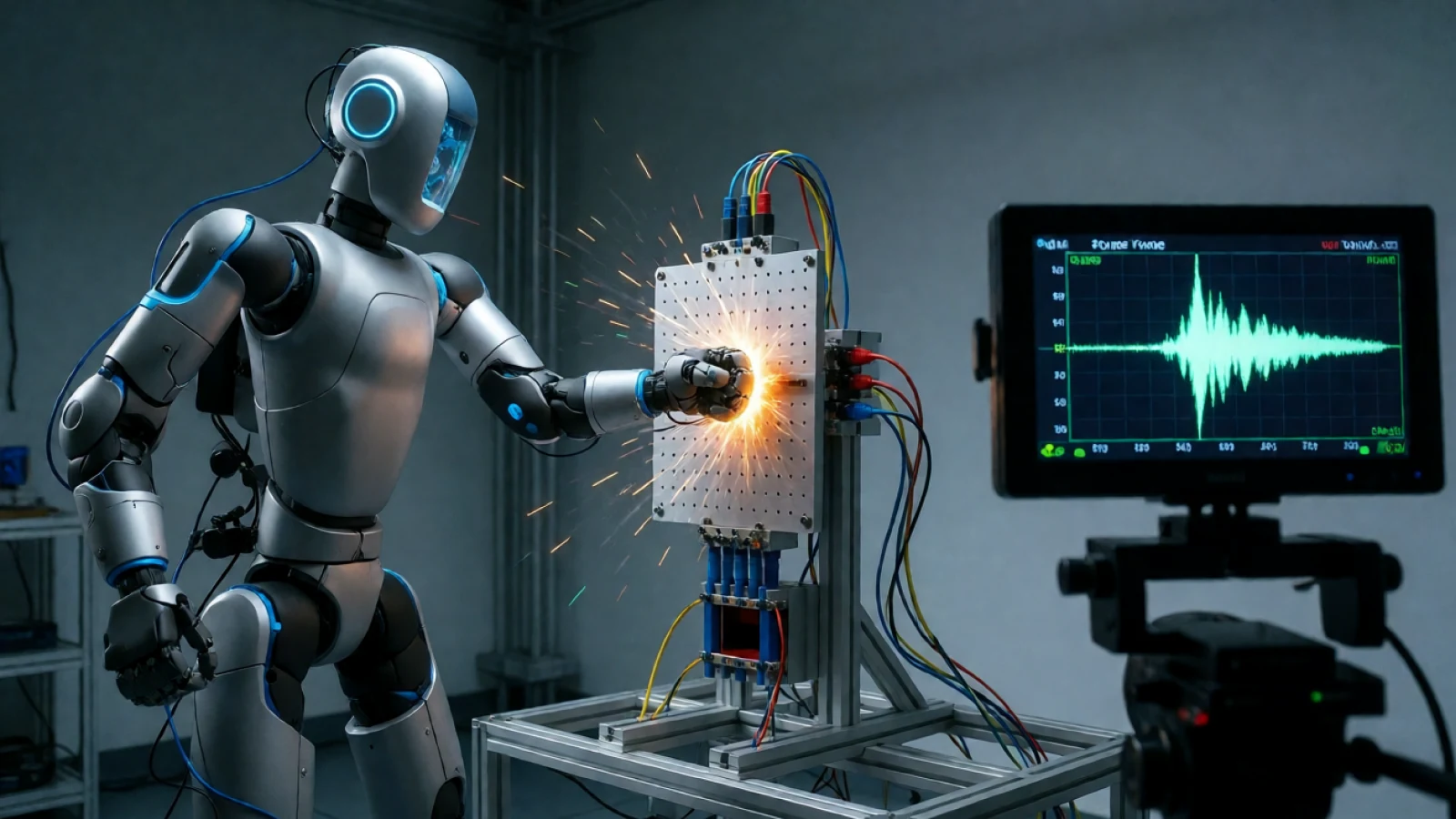
A typical punch-test system places one or more force sensors in the mechanical path between the target and its support. Depending on the design, this may be called a dynamometer, force plate, load-cell target or instrumented punching pad.
The essential requirement is that the impact travels through a measurement structure with a known response.
A simplified setup contains:
- a replaceable striking surface;
- a defined pad or target body;
- one or more load cells;
- a rigid, characterized mounting structure;
- signal conditioning and data acquisition;
- synchronized video or motion measurement;
- a safety enclosure and controlled robot operating area.
The sensor must be appropriate for the expected load direction and range. A device intended for slow compression tests is not automatically suitable for a short, multidirectional humanoid impact.
Research on human–robot impacts similarly uses instrumented setups with force sensing and motion or acceleration measurements. The important lesson is not to copy one device blindly; it is to preserve calibration, synchronized data and a documented collision configuration.
Why the whole target assembly matters
The measured waveform belongs to the striker–target–mounting system, not just the robot in isolation.
Results can change with:
- pad thickness, stiffness and damping;
- target mass and freedom to move;
- mounting rigidity;
- sensor placement and alignment;
- strike location on the pad;
- angle between the strike and sensor axis;
- whether the robot’s feet or body contact another structure.
A soft pad may spread contact over more time. A freely moving target may accelerate away, while a rigid fixture responds differently. Neither setup is inherently “wrong,” but their peak values should not be presented as equivalent.
A useful report includes photographs or drawings, target mass, support conditions, sensor model, measurement direction and any filtering applied.
Read the force-time curve, not only the maximum
An impact produces a waveform. Four features answer different questions.
Peak force
Peak force is the largest measured value within a defined interval. It is easy to quote and easy to misuse. It can be sensitive to contact stiffness, alignment, sampling and short-duration spikes.
Contact duration
This is the interval over which the striker and target remain in contact under a defined detection rule. A clear start and end threshold is necessary when signals are noisy or contain multiple contacts.
Impulse
Impulse is the area under the force-time curve during contact:
J = ∫F(t)dt
It relates force over time to momentum change in the analyzed system. Two impacts can have similar impulses with different peaks and durations.
Average force over contact
Average force can be calculated as impulse divided by the selected contact duration. It must be labeled with that interval; “average” without a time definition is ambiguous.
A strong test report can include all four features, repeated-trial distributions and the raw or archived waveforms needed to audit the result.
Calibration comes before striking
Calibration connects the sensor’s electrical output to a known force. A valid protocol should document:
- calibration equipment and reference standard;
- calibration date and relevant range;
- loading direction and alignment;
- zero or tare procedure;
- signal-conditioning settings;
- sampling and filtering configuration;
- checks before and after the test series.
A load-cell specification alone does not calibrate the assembled target. Mounting preload, structural friction, off-axis loads and cable or data-acquisition settings can affect the measured output.
The acquisition system also needs sufficient temporal resolution to capture the impact without missing or artificially shaping the peak. Filtering should be disclosed because aggressive smoothing can reduce peaks and alter duration.
A repeatable humanoid punch-test protocol
A defensible experiment should fix more than the robot model.
1. Identify the robot and software
Record the edition, mass-relevant accessories, protective equipment, battery configuration, control software and policy or motion version. State whether a human selects the strike and whether execution is preprogrammed or adaptive.
2. Define the starting state
Specify stance, foot positions, guard, joint or body posture, target distance and target height. Mark these positions so each trial begins from a comparable state.
3. Define the striking action
Identify the limb, strike type and intended trajectory. A jab, cross and full-body swinging strike are separate conditions. Do not pool them into one maximum.
4. Control operating condition
Record battery state and relevant temperatures. Allow a defined rest or cooling procedure between trials. A cold first strike and a hot repeated strike are different tests. Our humanoid thermal-management guide explains why duty cycle and rest conditions must remain visible in the results.
5. Repeat and retain all valid trials
Use a preregistered number of attempts and explicit validity criteria. Report failures, misses and outliers rather than selecting only the most impressive hit.
6. Publish summary statistics
Report the number of valid trials, central tendency, spread, maximum observed result and complete waveforms where possible. One peak from one attempt is not a stable platform rating.
Speed and acceleration are useful complements
High-speed video, motion capture or body-mounted sensors can help reconstruct the strike. They can identify fist speed, body motion, contact timing and whether the target was moving.
An accelerometer attached to a target can also provide useful information, but converting acceleration into force requires a defensible mass and mechanical model. If the target is connected to a support, rotates, deforms or has multiple contact paths, simply multiplying one acceleration by total mass can be wrong.
Force sensing and kinematics are strongest together:
- force sensors describe the contact load;
- motion data explain how the striker and target moved;
- synchronized timestamps connect the two records.
A knockdown in fight footage supplies none of the calibrated measurements needed to reconstruct an exact punch force retrospectively. Controller labels do not fill that gap either: our position-versus-force-control guide explains why a strike cannot be reduced to one large force setpoint.
What URKL’s dynamometer test establishes
Section 7 of URKL’s V2.0.0 rules includes striking-power evaluation using calibrated dynamometers. It provides two practice attempts and three official 30-second testing windows per discipline in the qualification process.
That is significant because the rules recognize instrumented strike testing rather than treating joint torque as punch power. It also means a URKL test value should be interpreted under the event’s target, timing and scoring protocol.
The existence of that procedure does not make every public “hardest punch” claim comparable. Before comparing results, confirm:
- whether the same dynamometer and target were used;
- whether the strike discipline was identical;
- whether the value is peak force or another score;
- whether all attempts or only the best were counted;
- whether the robot configuration and operating state were equivalent.
The official rules describe the testing framework; they do not turn unrelated gym-pad videos into standardized URKL data.
Common invalid comparisons
Avoid these shortcuts when evaluating humanoid striking claims:
- N·m to N without geometry and dynamics: torque is not contact force.
- One pad versus another pad: target construction changes the collision.
- Fastest fist versus hardest punch: speed does not define impact force.
- Peak versus impulse: one is an instantaneous maximum, the other integrates force over time.
- A fight knockdown versus a laboratory value: the opponent is not a calibrated target.
- Best highlight versus repeated trials: a selected maximum hides variability.
- Human head-impact tolerance versus robot scoring: different purposes and protocols should not be merged.
These distinctions are especially important for queries such as “is the T800 powerful?” The documented torque and physical demonstrations support a discussion of capability, but not an unmeasured universal punch rating.
Safety is part of the protocol
A full-size humanoid punch test involves stored energy, powerful actuators, moving limbs and possible loss of balance. The fixture should not introduce unstable supports or encourage operators to stand within the strike or fall envelope.
Use a controlled cell, remote initiation, emergency stopping, appropriate exclusion zones and inspection procedures. Instrumentation should be protected from loads outside its intended direction or range.
A test designed to produce a larger number at any cost may damage the robot or fixture while producing less useful science. Repeatability and traceability are better objectives than a single extreme clip.
The engineering takeaway
A meaningful humanoid punch-force result is not just a number in newtons. It is a number attached to a calibrated load path, a defined target, a disclosed robot state, synchronized force-time data and repeated trials.
Peak force, impulse and contact duration should remain distinct. Joint torque should remain rotational. And no viral replay can substitute for a dynamometer and a reproducible protocol.