
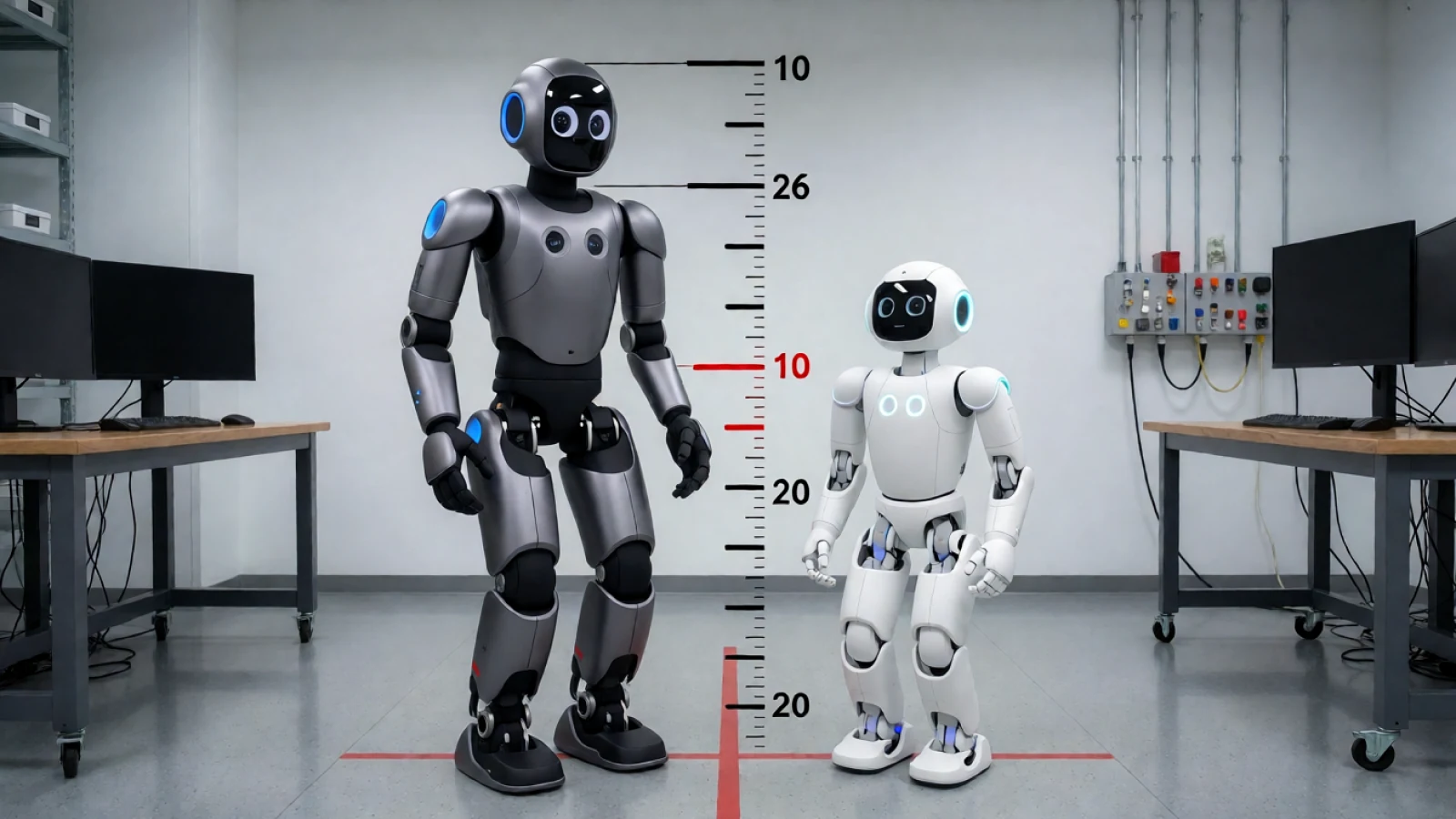
T800 vs. G1 official specification table
| Published item | EngineAI T800 | Unitree G1 / G1 EDU | |---|---|---| | Standing height | 173 cm | 132 cm | | Standing width × depth | Not used as a matching comparison item here | 45 × 20 cm | | Folded dimensions | Not used as a matching comparison item here | 69 × 45 × 30 cm | | Weight with battery | 75–85 kg, depending on configuration | About 35 kg; about 35 kg+ for EDU | | Total DOF | 25 Basic/Open Source; 43 Pro; 46 Max, including hand DOF where listed | 23 G1; 23–43 G1 EDU | | Leg DOF | Six per leg | Six per leg | | Published joint torque | Up to 450 N·m; maximum, not assigned to every joint | Knee: 90 N·m G1; 120 N·m G1 EDU | | Published arm or hand load | Pro/Max: 5 kg hand payload | About 2 kg arm load G1; about 3 kg EDU | | Vision and spatial sensing | Basic: Intel binocular camera; other editions: ultra-wide binocular camera + 3D LiDAR | Depth camera + 3D LiDAR | | Base computing | Eight-core CPU | Eight-core CPU | | High-computing option | Orin NX 16GB Basic; AGX Orin 64GB other editions; Thor on request for those editions | No high-computing module on standard G1; options such as Orin on EDU | | Cooling | Super Air-Cooled; active leg-joint cooling marketed | Local air cooling | | Battery | Quick-disassembly smart battery; product tables list 3–5 hours | Quick-release 9,000 mAh battery; about two hours advertised | | Secondary development | Listed for Open Source, Pro and Max; not Basic | Not standard G1; supported on G1 EDU | | Public standard price in cited source | No matching public all-edition price used here | From $13,500 for standard G1, excluding tax and shipping | | Warranty in cited source | Consult edition and warranty documentation | Eight months G1; 18 months G1 EDU |
These are manufacturer specifications, not results from one independent laboratory or a shared combat protocol. Several rows intentionally compare different scopes, such as a general maximum joint torque and a knee-specific value.
For broader context, browse our robot profiles and comparisons.
Size and mass: this is not a like-for-like fight pairing
The G1 is 41 cm shorter than the T800 in the published standing dimensions. Its standard mass of about 35 kg is also far below the T800’s 75–85 kg range.
That difference affects nearly every physical comparison:
- the mass that actuators must accelerate;
- reach and whole-body geometry;
- floor loading and foot-contact dynamics;
- collision momentum;
- transport and handling requirements;
- protective structures and test-cell design.
It would be misleading to treat a T800–G1 exchange as evidence that one product line is universally superior. A meaningful combat evaluation would need explicit weight-class rules, equivalent test conditions and repeated trials. Public product specifications do not provide that matchup.
For research teams, the smaller G1 may present different logistics from a full-size T800. “Easier to handle” still does not mean safe to operate without appropriate procedures; both manufacturers’ specifications describe powerful articulated machines, not toys.
DOF: edition and counting method change the comparison
The T800 range has three distinct published totals:
- Basic and Open Source: 25 DOF;
- Pro: 29 body DOF + 14 hand DOF = 43;
- Max: 32 body DOF + 14 hand DOF = 46.
The G1 lists 23 DOF, while G1 EDU spans 23–43 DOF depending on configuration. Unitree’s optional hand, wrist and waist axes explain why one EDU number cannot describe every unit.
A headline such as “T800 Max has 46 versus G1’s 23” compares a hand-inclusive, highest-articulation T800 with the standard G1. It may be numerically correct for those configurations but incomplete as a platform verdict.
More DOF can create more possible postures and movements. It also adds actuators, control states, power demands and potential failure points. Usable joint range, coordination and control quality matter more than the count alone.
Our T800 profile separates body and hand totals across EngineAI’s lineup.
Torque: 450 N·m and 120 N·m are not the same scope
EngineAI publishes maximum torque of up to 450 N·m for the T800. Unitree publishes a maximum knee-joint torque of 90 N·m for G1 and 120 N·m for G1 EDU.
There are three reasons not to turn this into a simple strength ratio:
- Joint scope: the G1 figure explicitly concerns the knee; the T800 headline is not assigned to every joint.
- Rating conditions: the public rows do not establish matching speed, duration, duty cycle, voltage and temperature conditions.
- Physical output: joint torque is rotational and does not directly equal punching force, kicking force or whole-body strength.
Even a perfectly verified torque comparison would not predict a fight outcome. Strike mechanics also depend on segment motion, posture, effective mass, contact, control and the target.
Read the T800 specification profile for the published figures, and how to measure humanoid punch force for a valid impact-test framework.
Sensors and computing: compare exact editions
The standard G1 and G1 EDU both list a depth camera and 3D LiDAR, plus an eight-core CPU. Standard G1 does not list the high-computing module; EDU offers options including Orin.
The T800 sensor package changes more sharply by edition:
- Basic lists an Intel binocular camera, Orin NX 16GB and no 3D LiDAR in the product table.
- Open Source, Pro and Max list an ultra-wide binocular camera, 3D LiDAR and AGX Orin 64GB, with Thor available on request.
That means there is no single “T800 versus G1 sensor winner.” A T800 Basic and a T800 Open Source should not be substituted for one another in the same comparison.
Sensor presence also says little about perception quality. Resolution, calibration, synchronization, software, latency and robustness to occlusion determine what the robot can actually use.
For a deeper breakdown, see T800 sensors explained and T800 computing configurations.
Development access is a fundamental dividing line
Unitree states that secondary development is not supported on standard G1 and is supported on G1 EDU. EngineAI lists secondary development for T800 Open Source, Pro and Max, but not for Basic.
For a research purchase, the relevant comparison is therefore usually:
- T800 Open Source/Pro/Max versus G1 EDU for programmable development;
- standard editions versus standard editions only for their delivered capabilities.
Buying a lower-cost standard unit and assuming EDU-level or open-platform access would be a procurement error. Teams should verify APIs, low-level control access, sensor streams, licensing, documentation and support for the exact configuration.
Battery figures answer different questions
T800 product tables list 3–5 hours and quick battery disassembly. Unitree lists a 9,000 mAh quick-release battery and approximately two hours for G1.
The G1’s capacity in milliamp-hours is not directly comparable with an hours figure without voltage, energy and load information. Conversely, the T800’s longer advertised runtime range does not prove more combat endurance.
Runtime depends on posture, movement, computation, environmental conditions and configuration. Repeated strikes, recoveries and high-compute perception create a very different load from a light demonstration. Neither runtime statement is a standardized fight test.
Which platform is better for robot combat?
The T800 has the clearer documented connection to URKL in the sources used across this site. That provides event-specific footage and rules through which to examine strikes, falls and recovery.
The G1’s specifications establish a smaller humanoid platform with depth sensing, 3D LiDAR and an EDU development route. They do not create a standardized T800-versus-G1 bout record.
A defensible combat evaluation would require:
- disclosed configurations and mass;
- the same legal strike set and target conditions;
- calibrated force and performance measurements;
- repeated contacts rather than selected highlights;
- recovery and damage records;
- thermal and battery status;
- transparent allocation of human and autonomous decisions.
Until then, “T800 would beat G1” is an entertainment prediction, not an engineering conclusion.
Which is better for a research team?
Consider the T800 development editions when the project requires a full-size 173 cm platform, the listed EngineAI sensor/compute package and secondary development. Pro and Max may be relevant when their additional body and hand articulation is required.
Consider G1 EDU when a smaller, lighter humanoid is preferable and the project needs Unitree’s documented secondary-development route, depth camera, 3D LiDAR and optional high computing.
The G1’s published standard starting price can help early budgeting, but it should not be compared with an unknown or differently configured T800 price. Include batteries, computing, support, spares, shipping, taxes and safety infrastructure in either procurement.
Verdict: different platforms, not one specification winner
The T800 is substantially taller and heavier, offers several full-size configurations and publishes a much larger maximum joint-torque headline. The G1 is more compact, lists depth vision and 3D LiDAR across standard and EDU versions, and provides a clearly separated EDU development path.
The most important comparison is not which robot looks more intimidating. It is whether the exact edition, software access and physical platform match the intended experiment. No official specification table establishes a universal combat or research winner.