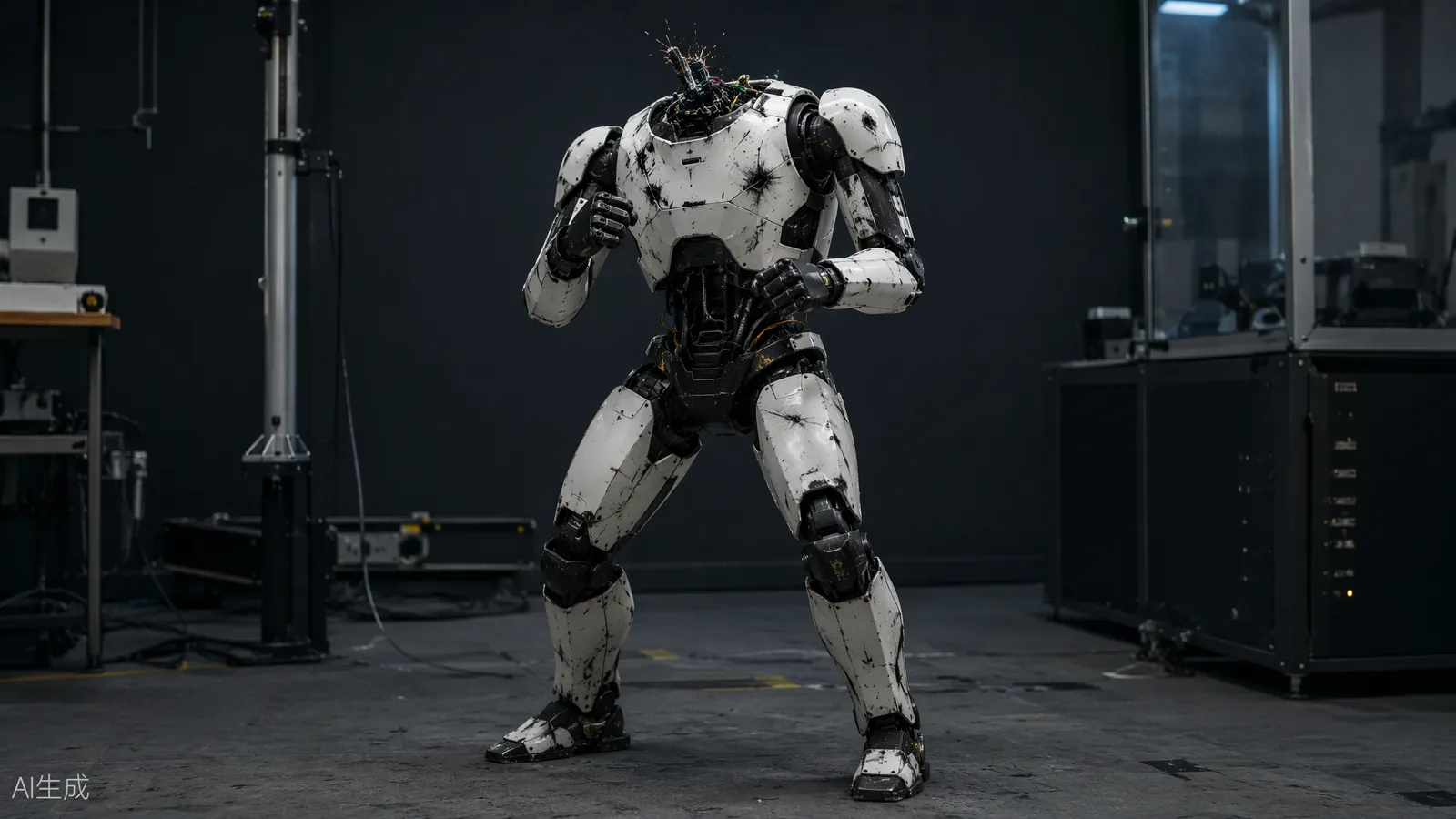
In the final round of the URKL opening night on July 16, 2026, White Eagle landed two flying kicks that tore Matador's head completely off. The dark robot kept throwing punches with its head dangling by cables until the bell. This article — a satellite of how a humanoid robot fights — breaks down the engineering behind the most-watched moment in robot combat so far. (For the fight itself and its result, our sister site URKL News has full coverage.)
What actually happened
Per on-site reporting, the first kick rocked Matador's head and the second detached it. The T800 did not fall: it remained upright, continued exchanging strikes, and finished the round before being carried off. The sequence lasted seconds; the engineering explanation takes longer.
Why it kept fighting: the brain is in the torso
The decapitation was survivable because of where the machine keeps its intelligence. The T800's control electronics and balance-critical systems reside in the torso; the head primarily houses perception hardware. Losing head-mounted sensors degrades the robot — vision and part of its environmental awareness go dark — but the balance loop and motor control that keep 75 kg upright and punching never stopped running.
That is architectural redundancy: critical functions distributed so that no single impact point is fatal. Organizers leaned on exactly those words afterward, stating the incident demonstrated the platform's structural durability, redundancy and resilience under combat conditions.
Durability by design
The frame helps too. The T800's body is aerospace-grade magnesium-aluminum alloy, chosen for high durability at low weight — a chassis meant to take hits, not just pose for demos. Combined with active-cooled leg joints built for sustained peak output, the platform is engineered around the assumption of repeated impact.
What has not been disclosed
- The exact sensor and cabling layout damaged in the decapitation
- Whether the head unit is modular/field-replaceable between bouts
- Post-fight inspection findings or repair time for the damaged unit
- Impact-force figures the neck assembly is rated to withstand
What happens next
Durability data is the scarcest resource in humanoid robotics — which is why every URKL fight doubles as a stress-test dataset. Back to the pillar: actuation, balance and recovery engineering. The framework that governs what teams may repair and modify between bouts: URKL's confirmed rules.