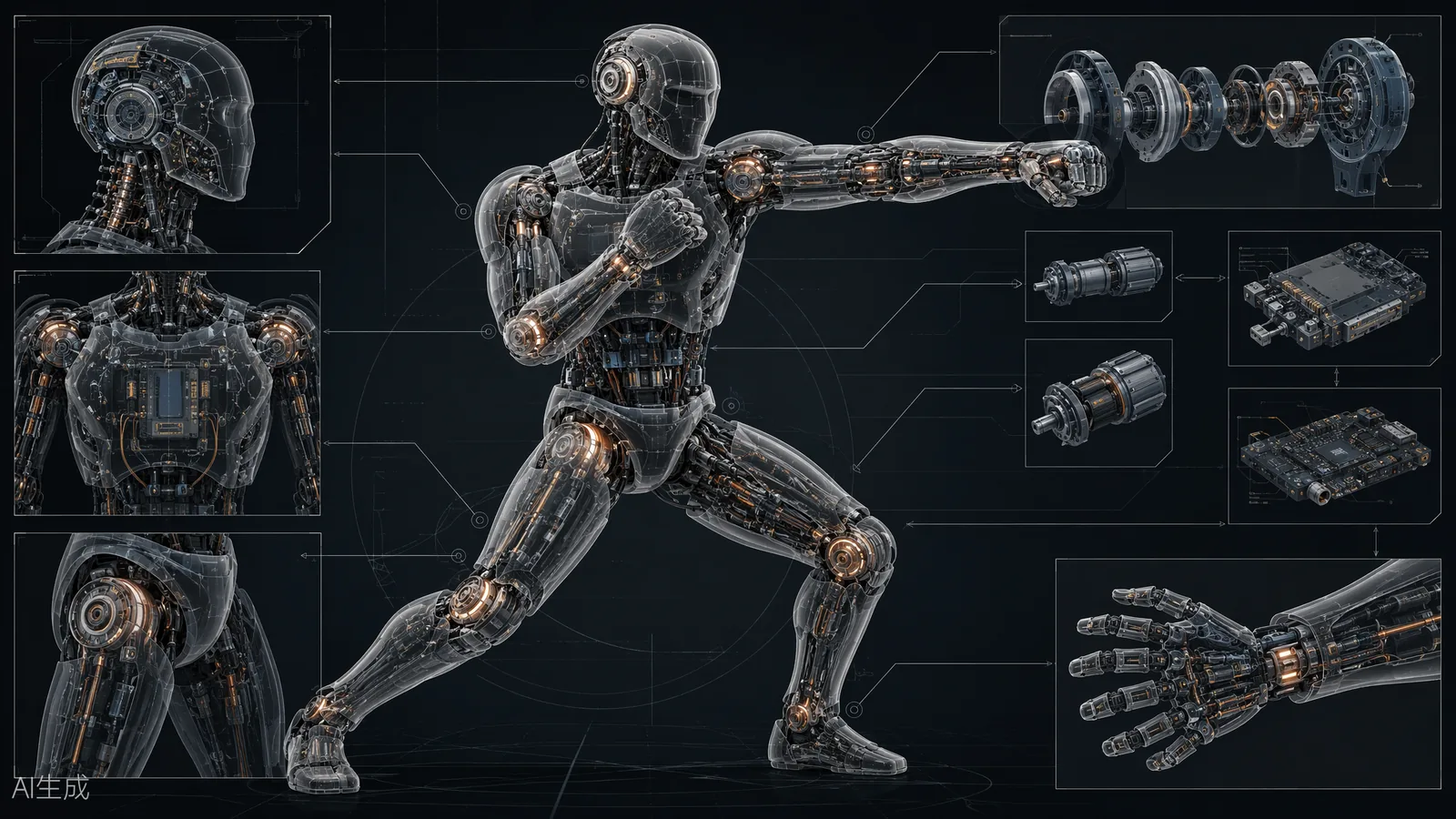
Strip away the arena lights and a robot fight is three engineering problems solved in real time: delivering force, staying upright, and getting back up. This is the reference page of our Engineering hub — each section below links the physics to sourced figures from the only combat humanoid currently in a league, the EngineAI T800.
Actuation: 450 N·m at the joint
A humanoid strike is a torque problem. To accelerate a multi-kilogram limb into a fight-ending kick, the T800's joints deliver up to 450 N·m (332 lb·ft) — the manufacturer figure that puts its athletic output, on paper, at or above human-athlete level.
Sustaining that output is a thermal problem: combat is repeated peak load, not a single demo. The T800's leg joints carry an active cooling system designed to hold high performance continuously without overheating.
Balance control: 29 DOF, one body, constant stabilization
A biped that punches is a biped that pushes itself over. Every strike throws reaction forces back through the frame, and every hit received arrives unannounced. The T800 balances 29 body degrees of freedom as a single coupled system — ankles, knees, hips, spine, shoulders — correcting posture continuously through its perception loop.
This is why fight footage shows robots adjusting their stance between exchanges like boxers: the controller is solving for stability first and attack second.
Recovery engineering: the knockdown is not the end
Falls are inevitable; staying down is optional. Autonomous recovery behaviors let a fallen humanoid detect its orientation, plant its limbs and execute a stand-up sequence unaided. At the URKL opening event on July 16, 2026, robots that fell from their own kicks were observed rising within seconds — the difference between a 3-point knockdown and a stoppage.
Recovery is where fight engineering meets durability: the frame must survive the impact for the software to get a chance to stand up. We dissected the extreme case — a robot fighting on without its head — in our impact resilience analysis.
Perception and compute
Sensing feeds everything above. The T800 runs a 360° LiDAR with millisecond-level environmental processing, on an Intel N97 CPU paired with an NVIDIA AGX Orin module (275 TOPS). That pipeline handles navigation and obstacle avoidance; the precise sensor fusion used in combat decision loops has not been disclosed.
Power and endurance
The T800's modular solid-state battery is rated for up to four hours of high-intensity operation — a laboratory figure. Endurance under repeated combat load is a different, undisclosed number, and battery swaps mid-fight sit in the timeout framework covered by URKL's confirmed rules.
What has not been disclosed
- Detailed actuator specifications per joint (peak vs continuous torque curves)
- The combat decision-stack architecture (autonomy vs teleoperation split in fights)
- Battery endurance under combat load; charge/swap times during events
- Frame fatigue data after repeated knockdowns and strikes
What happens next
Satellite analyses are rolling out to this hub: the 450 N·m torque deep-dive, the 29-DOF balance problem, battery endurance under combat load, and the perception stack. The ecosystem that builds these machines: Inside Shenzhen.